Abstract
Docosahexaenoic acid (DHA), a long-chain omega-3 polyunsaturated fatty acid, is a vital structural component of the brain and retina and plays an essential role during the first 1,000 days of life, including toddlerhood. This developmental period is marked by rapid brain growth, synaptogenesis, myelination, and neural circuit refinement, all of which require an adequate supply of essential nutrients. Among these, DHA is especially important because it is highly concentrated in neuronal membranes, where it helps maintain membrane fluidity, supports synaptic signaling, and promotes efficient communication between nerve cells. DHA contributes significantly to neurodevelopment by supporting neurite outgrowth, neuronal differentiation, and cell survival. These processes are critical during toddlerhood, when children experience major advances in language, memory, learning, motor skills, and emotional regulation. Because DHA influences the structural and functional maturation of the brain, it is often associated with improved visual and cognitive development. Experimental studies strongly support its biological importance in brain development, showing that DHA enhances synaptic plasticity and protects neurons from injury. Human studies also suggest benefits, particularly in visual acuity, attention, and certain cognitive functions, although the outcomes of DHA supplementation trials are not always consistent. In addition to its effects on cognition, DHA may also influence behavioral outcomes. Adequate DHA status has been linked with better attention, emotional balance, and adaptive behavior, likely because it supports the maturation of brain regions involved in self-regulation and social functioning. However, clinical evidence in this area remains mixed, and more toddler-specific research is needed to confirm these effects. DHA also has an important immunomodulatory role. It serves as a precursor for bioactive lipid mediators such as resolvins, protectins, and maresins, which help reduce excessive inflammation and promote immune homeostasis. By modulating cytokine production and inflammatory signaling pathways, DHA may support immune maturation during early life. Overall, DHA is functionally significant during toddlerhood because of its combined roles in brain development, cognitive performance, behavioral regulation, and immune function. However, the magnitude of its benefits may vary depending on dietary intake, baseline nutritional status, timing, and dose of supplementation. Thus, DHA should be considered a key nutrient for supporting healthy early childhood development.
|
Published in
|
American Journal of Pediatrics (Volume 12, Issue 2)
|
|
DOI
|
10.11648/j.ajp.20261202.11
|
|
Page(s)
|
55-62 |
|
Creative Commons
|

This is an Open Access article, distributed under the terms of the Creative Commons Attribution 4.0 International License (http://creativecommons.org/licenses/by/4.0/), which permits unrestricted use, distribution and reproduction in any medium or format, provided the original work is properly cited.
|
|
Copyright
|
Copyright © The Author(s), 2026. Published by Science Publishing Group
|
Keywords
DHA (Docosahexaenoic Acid), Toddlerhood, Brain Development, Cognitive Function, Behavioral Outcomes,
Immunomodulation, Omega-3 Fatty Acids
1. Introduction
Toddlerhood represents a crucial stage of human growth and development, characterized by rapid and complex changes in physical, neurological, cognitive, and emotional domains. During this period, children undergo remarkable progress in language acquisition, motor coordination, memory formation, attention span, problem-solving ability, emotional regulation, and social interaction. These developmental achievements are supported by dynamic changes in brain structure and function, including synapse formation, myelination, neuronal connectivity, and cortical maturation. Because of this intense developmental activity, toddlerhood is widely recognized as a sensitive window during which environmental and nutritional influences can have lasting effects on brain architecture and long-term developmental outcomes.
Among the nutritional factors that contribute to optimal early childhood development, docosahexaenoic acid (DHA) has received substantial scientific attention. DHA is a long-chain omega-3 polyunsaturated fatty acid that serves as a major structural component of neuronal membranes and retinal tissue. It is especially concentrated in the phospholipid bilayer of brain cells, where it contributes to membrane fluidity, receptor function, signal transduction, and synaptic communication. Its high concentration in neural tissue underscores its biological importance during periods of rapid brain growth, particularly in the prenatal stage, infancy, and toddlerhood. Since the brain continues to develop significantly during the early years of life, adequate DHA availability remains essential beyond infancy and into the toddler years.
The first 1,000 days of life, extending from conception to approximately two years of age, are often emphasized as a foundational period for neurodevelopment and future health. Toddlerhood overlaps with the latter part of this window and remains a phase of continued synaptic remodeling, neural circuit refinement, and functional maturation. During this time, the child’s brain is actively organizing itself in response to both genetic programming and external influences, including diet. Nutrients that support cellular growth, neurotransmission, and structural integrity are therefore especially important. DHA is one such nutrient, as it plays both structural and functional roles in the developing central nervous system. Reviews of nutritional interventions during the first 1,000 days consistently identify DHA as a key nutrient for neurodevelopment, although they also caution that evidence from randomized controlled trials is more variable than the strong biological rationale might predict.
One reason DHA is of such interest is that the human body has only a limited ability to synthesize it from alpha-linolenic acid (ALA), the shorter-chain omega-3 fatty acid found in plant foods such as flaxseed, chia seeds, walnuts, and certain vegetable oils. Although this conversion pathway exists, it is relatively inefficient, meaning that endogenous production alone may not be sufficient to meet the needs of rapidly developing tissues, especially during early life. As a result, dietary intake of preformed DHA becomes particularly important. The richest dietary sources of DHA are oily fish and other marine foods, including salmon, sardines, mackerel, tuna, and anchovies. Smaller amounts may also be obtained from fortified foods such as certain dairy products, eggs, infant formulas, and toddler milks.
Despite its importance, dietary intake of DHA and other long-chain omega-3 fatty acids among young children is often lower than recommended or considered desirable in many populations. This may result from low fish consumption, limited dietary diversity, economic barriers, cultural food practices, or lack of awareness regarding the nutritional significance of omega-3 fatty acids. In some settings, parents may avoid fish in young children’s diets because of concerns about allergies, bones, taste acceptance, or contamination, which can further reduce DHA intake during a critical developmental period. These dietary limitations have led researchers and health professionals to explore the value of DHA-fortified foods and supplements as practical strategies to support early childhood nutrition and developmental health.
The scientific interest in DHA during toddlerhood extends beyond its role as a structural lipid. Researchers have increasingly examined how DHA may influence higher-order developmental outcomes such as cognition, learning, behavior, and immune function. Mechanistically, DHA has been shown to support synaptic plasticity, neuronal differentiation, and cell survival, while also acting as a precursor for anti-inflammatory and pro-resolving lipid mediators. These multiple functions suggest that DHA may play a broad and integrated role in supporting healthy child development. However, although experimental studies strongly support these mechanisms, findings from human intervention studies remain somewhat inconsistent. Some studies suggest improvements in visual acuity, attention, or specific cognitive domains, whereas others report only limited or no measurable benefits.
This apparent inconsistency does not necessarily diminish the importance of DHA but rather reflects the complexity of nutrition research in early childhood. The effects of DHA may depend on several interacting factors, including baseline nutritional status, dosage, duration of intake, timing of exposure, presence of other nutrients, genetic factors, and the developmental measures used to assess outcomes. Therefore, understanding the role of DHA during toddlerhood requires both recognition of its biological significance and careful interpretation of the available clinical evidence.
Overall, toddlerhood is a sensitive developmental stage during which adequate nutrition is essential for healthy brain growth and functional maturation. Within this context, DHA stands out as a nutrient of particular importance due to its structural role in the brain, its contribution to neural communication, and its broader influence on cognitive, behavioral, and physiological processes. As interest in early childhood nutrition continues to grow, DHA remains a central focus in discussions of how diet can support optimal developmental outcomes during the formative years of life.
2. Significance of DHA in Toddlerhood for Brain Maturation, Cognitive Development, Behavioral Function, and Immunomodulatory Processes
2.1. DHA and Brain Development
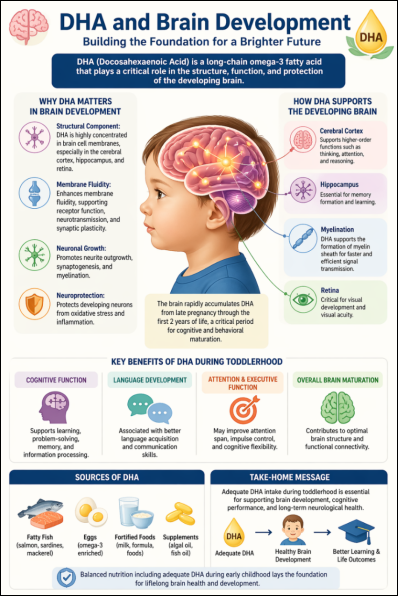
DHA is a major structural lipid in the central nervous system, especially in synaptic membranes and other phospholipid-rich neural tissues. Its unique physicochemical properties help maintain membrane flexibility and fluidity, which are essential for receptor function, ion channel activity, vesicle fusion, and synaptic transmission. Experimental work further shows that DHA supports neurite extension, neuronal differentiation, synaptogenesis, and survival signaling
| [1] | Giedd J. N., Blumenthal J., Jeffries N. O., Castellanos F. X., Liu H., Zijdenbos A., Paus T., Evans A. C., Rapoport J. L. 1999. Brain development during childhood and adolescence: a longitudinal MRI study. Nat. Neurosci. 2: 861–863. |
[1]
.
These effects are highly relevant during toddlerhood, when the brain is still undergoing intense synaptic remodeling and myelination. A particularly important point is that brain DHA accretion continues after birth and remains substantial through the first two years of life. Because toddlerhood overlaps with this later part of the first 1,000 days, adequate DHA supply may help support ongoing cortical and subcortical maturation, including circuits involved in learning, executive control, and emotional regulation. However, the biological importance of DHA does not automatically mean that adding more DHA beyond adequate intake will always improve developmental outcomes in every child
| [3] | Kim HY, Huang BX, Spector AA. Molecular and Signaling Mechanisms for Docosahexaenoic Acid-Derived Neurodevelopment and Neuroprotection. International Journal of Molecular Sciences. 2022. |
[3]
.
2.2. Mechanism of Action of DHA
DHA acts through both structural and signaling mechanisms.
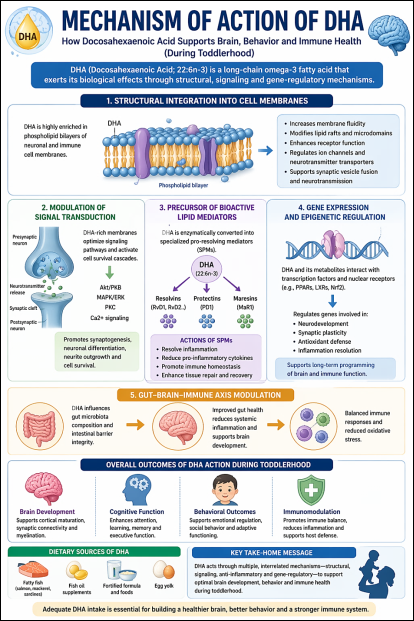
First, as a highly unsaturated fatty acid incorporated into membrane phospholipids, it increases membrane fluidity and changes the organization of lipid microdomains, thereby affecting receptor trafficking, ion channels, neurotransmitter release, and intracellular signal transduction. In neurons, DHA-rich membranes favor signaling events that support synaptic function and plasticity.
Second, DHA promotes the formation of phosphatidylserine-enriched membrane domains, which facilitate activation of survival-related kinases such as Akt, PKC, and Raf-1. These pathways support neuronal differentiation, neurite outgrowth, synaptogenesis, and resistance to apoptotic injury. This helps explain why DHA is repeatedly linked to neuronal growth and neuroprotection in cell and animal models
| [5] | Lauritzen L, Brambilla P, Mazzocchi A, et al. DHA Effects in Brain Development and Function. Nutrients. |
[5]
.
Third, DHA can regulate gene expression directly or indirectly through transcriptional mechanisms and via its oxygenated metabolites. DHA-derived mediators such as neuroprotectin D1, resolvins, and maresins dampen excessive inflammatory signaling, reduce pro-inflammatory cytokine production, promote resolution of inflammation, and enhance cellular survival responses. These actions provide a mechanistic bridge between DHA’s neurodevelopmental and immunomodulatory roles.
Finally, newer literature suggests that DHA may also interact with the gut–brain–immune axis. Reviews propose that microbiome development, intestinal barrier function, and inflammatory tone could partly mediate the developmental effects of DHA in early life, although this remains an active research area rather than a settled conclusion.
2.3. DHA and Cognitive Functions
Cognitive domains most often discussed in relation to DHA include visual processing, attention, learning, memory, and executive function. Mechanistically, DHA may support cognition by improving membrane-dependent signaling, synaptic efficiency, and neuronal resilience. Human evidence is suggestive but mixed. Some reviews and trials report benefits in selected subgroups or domains, whereas larger systematic reviews and meta-analyses conclude that overall effects of prenatal or early postnatal DHA supplementation on global neurodevelopmental scores are small or inconsistent
| [6] | Janssen CIF, Kiliaan AJ. The Role of Docosahexaenoic Acid in Neural Development and Function: Learning and Behavior. |
[6]
.
This mixed evidence should be interpreted carefully. A null or modest effect in pooled analyses does not negate DHA’s biological necessity; rather, it suggests that trial outcomes depend on factors such as the timing of intervention, background diet, concurrent nutrients such as arachidonic acid and choline, developmental risk status, and the sensitivity of cognitive tests used. Thus, DHA appears to be necessary for normal neurodevelopment, but the measurable benefit of supplementation above usual intake is not uniform across studies.
2.4. DHA and Behavioral Outcomes | [7] | Bragg MG, Prado EL, Stewart CP. Choline and docosahexaenoic acid during the first 1000 days and children’s health and development in low- and middle-income countries. Nutrition Reviews. 2022. |
[7]
Behavioral outcomes linked to DHA include attention, emotional control, social behavior, and externalizing symptoms such as hyperactivity or impulsivity. A review of trials in the first 1,000 days found that the behavioral evidence is variable and not consistently favorable across all studies. At the same time, some individual trials in older children have reported improvements in behavior ratings, especially in children with lower baseline academic performance or specific learning-related difficulties. Together, these findings suggest a plausible role for DHA in behavioral regulation, but they do not support broad claims of universal behavioral benefit from supplementation.
For an article focused on toddlerhood, the most defensible conclusion is that DHA likely supports the neural systems underlying behavior, while direct toddler-specific intervention evidence remains more limited than the mechanistic literature. Therefore, claims about behavior should be framed as promising but not definitive
| [8] | Gould JF, Smithers LG, Makrides M. The Influence of Omega-3 Long-Chain Polyunsaturated Fatty Acid, DHA, on Child Behavioral Functioning. Nutrients. 2021. |
| [16] | Weiser MJ, Wynalda K, Salem N Jr, Butt CM. Dietary DHA during development affects depression-like behaviors and biomarkers that emerge after puberty in adolescent rats. J Lipid Res. 2015 Jan; 56(1): 151-66.
https://doi.org/10.1194/jlr.M055558 Epub 2014 Nov 19. |
[8, 16]
.
2.5. DHA and Immunomodulation
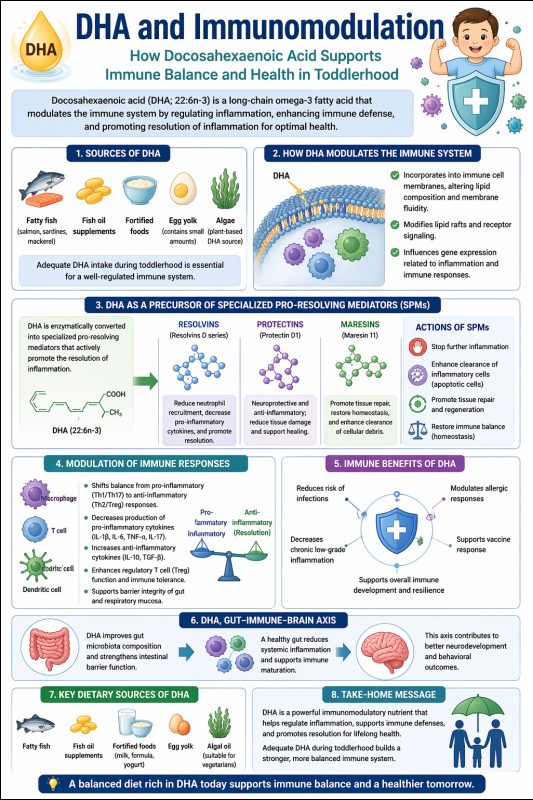
Beyond the nervous system, DHA contributes to immune maturation and immunoregulation. It can alter immune cell membrane composition, influence membrane microdomains and receptor signaling, and shift eicosanoid and cytokine profiles toward a less pro-inflammatory state. Most importantly, DHA serves as a precursor for specialized pro-resolving mediators, including D-series resolvins, protectins, and maresins, which help terminate inflammation and promote tissue homeostasis rather than merely suppressing inflammatory pathways
| [9] | Richardson AJ, Burton JR, Sewell RP, et al. Docosahexaenoic Acid for Reading, Cognition and Behavior in Children Aged 7–9 Years: A Randomized, Controlled Trial. PLoS ONE. 2012. |
| [10] | Serhan CN, Levy BD. Specialized Pro-Resolving Mediator Network: An Update on Production and Actions. |
| [15] | Mulder KA, Dyer RA, Elango R, Innis SM. Complexity of understanding the role of dietary and erythrocyte docosahexaenoic acid (DHA) on the cognitive performance of school-age children. Curr Dev Nutr. 2022 Jun 16; 6(7): nzac099.
https://doi.org/10.1093/cdn/nzac099 |
[9, 10, 15]
.
This immunomodulatory role may be particularly relevant in early life, when immune and barrier systems are still maturing. Reviews covering the first 1,000 days note that DHA may influence inflammation and morbidity, although the strongest mechanistic evidence comes from experimental and translational studies rather than toddler-specific clinical endpoints. In practical terms, DHA may help shape a more balanced inflammatory response and support recovery from inflammatory stress through pro-resolving pathways
| [12] | Arulselvan P, et al. Immunomodulatory Effects of Omega-3 Fatty Acids: Mechanistic Insights and Clinical Relevance. |
| [13] | Crippa A, Tesei A, Sangiorgio F, Salandi A, Trabattoni S, Grazioli S, Agostoni C, Molteni M, Nobile M. Behavioral and cognitive effects of docosahexaenoic acid in drug-naïve children with attention-deficit/hyperactivity disorder: a randomized, placebo-controlled clinical trial. Eur Child Adolesc Psychiatry. 2019 Apr; 28(4): 571-583.
https://doi.org/10.1007/s00787-018-1223-z Epub 2018 Sep 24. |
[12, 13]
.
3. Conclusion
DHA is functionally significant during toddlerhood because it supports several fundamental processes involved in brain maturation and neural development. As a major structural component of neuronal membranes, DHA helps maintain membrane fluidity, integrity, and organization, which are essential for efficient cell signaling and communication within the brain. It also contributes to synaptic signaling, neuronal differentiation, and neuroprotection, all of which are critical during toddlerhood, a period marked by rapid cognitive, emotional, and behavioral development. Because the brain is still undergoing active synapse formation, myelination, and circuit refinement during this stage, adequate DHA availability may play an important role in supporting these developmental processes.
In addition to its structural role in the brain, DHA has been associated with functions related to attention, learning, memory, and behavioral regulation. Some evidence suggests that sufficient DHA status may help support cognitive performance and improve aspects of emotional and social functioning by enhancing the maturation of neural pathways involved in self-regulation. However, although biological and experimental studies strongly support these mechanisms, the findings from human clinical studies are less consistent. Some trials report beneficial effects of DHA supplementation on cognitive or behavioral outcomes, whereas others show limited or no measurable improvement. Therefore, the current literature does not support exaggerated or universal claims regarding DHA supplementation, particularly when dietary intake is already adequate.
DHA also plays an important role in immunomodulation. It influences immune signaling by modifying cell membrane composition and regulating inflammatory pathways. Moreover, DHA serves as a precursor to specialized pro-resolving mediators, including resolvins, protectins, and maresins, which help reduce excessive inflammation and restore immune balance. This makes DHA relevant not only to neurodevelopment but also to immune homeostasis during early life.
Overall, DHA should be regarded as a biologically important nutrient for normal brain development and immune function during toddlerhood. However, the benefits of additional supplementation beyond an already sufficient diet appear to depend on context, including baseline nutritional status, dose, timing, and individual developmental needs. For academic and scholarly writing, DHA is best presented as an essential developmental nutrient with strong mechanistic support and promising, though not universally consistent, clinical evidence.
Author Contributions
Shaiful Azam: Conceptualization, Data curation, Formal Analysis, Investigation, Methodology, Project administration, Supervision, Validation, Visualization, Writing – original draft, Writing – review & editing
Mizanur Rahman: Conceptualization, Data curation, Formal Analysis, Investigation, Methodology, Supervision, Visualization, Writing – original draft
Debashish Saha: Conceptualization, Data curation, Formal Analysis, Investigation, Methodology, Project administration, Visualization
Amir Ul Mulk: Conceptualization, Data curation, Formal Analysis, Investigation, Validation, Visualization, Writing – original draft
Rasheduzzaman Khan: Conceptualization, Data curation, Formal Analysis, Investigation, Methodology, Project administration, Supervision, Validation, Visualization, Writing – original draft, Writing – review & editing
Rajesh Majumdar: Conceptualization, Data curation, Formal Analysis, Investigation, Methodology, Project administration
Mohammad Tofazzal Hossain: Conceptualization, Data curation, Formal Analysis, Investigation, Methodology, Project administration, Supervision, Validation, Visualization, Writing – original draft
Din Islam: Conceptualization, Data curation, Formal Analysis, Investigation, Methodology, Project administration
Conflicts of Interest
The authors declare no conflicts of interest.
References
| [1] |
Giedd J. N., Blumenthal J., Jeffries N. O., Castellanos F. X., Liu H., Zijdenbos A., Paus T., Evans A. C., Rapoport J. L. 1999. Brain development during childhood and adolescence: a longitudinal MRI study. Nat. Neurosci. 2: 861–863.
|
| [2] |
Hu R, Xu J, Hua Y, et al. Could early life DHA supplementation benefit neurodevelopment? A systematic review and meta-analysis. Frontiers in Neurology. 2024.
|
| [3] |
Kim HY, Huang BX, Spector AA. Molecular and Signaling Mechanisms for Docosahexaenoic Acid-Derived Neurodevelopment and Neuroprotection. International Journal of Molecular Sciences. 2022.
|
| [4] |
Sun GY, Simonyi A, Fritsche KL, et al. Docosahexaenoic acid (DHA): An essential nutrient and a nutraceutical for brain health and diseases. Prostaglandins, Leukotrienes and Essential Fatty Acids.
|
| [5] |
Lauritzen L, Brambilla P, Mazzocchi A, et al. DHA Effects in Brain Development and Function. Nutrients.
|
| [6] |
Janssen CIF, Kiliaan AJ. The Role of Docosahexaenoic Acid in Neural Development and Function: Learning and Behavior.
|
| [7] |
Bragg MG, Prado EL, Stewart CP. Choline and docosahexaenoic acid during the first 1000 days and children’s health and development in low- and middle-income countries. Nutrition Reviews. 2022.
|
| [8] |
Gould JF, Smithers LG, Makrides M. The Influence of Omega-3 Long-Chain Polyunsaturated Fatty Acid, DHA, on Child Behavioral Functioning. Nutrients. 2021.
|
| [9] |
Richardson AJ, Burton JR, Sewell RP, et al. Docosahexaenoic Acid for Reading, Cognition and Behavior in Children Aged 7–9 Years: A Randomized, Controlled Trial. PLoS ONE. 2012.
|
| [10] |
Serhan CN, Levy BD. Specialized Pro-Resolving Mediator Network: An Update on Production and Actions.
|
| [11] |
de Bus I, Witkamp R, Zuilhof H, et al. Resolvins, Protectins, and Maresins: DHA-Derived Specialized Pro-Resolving Mediators. Molecules. 2022.
|
| [12] |
Arulselvan P, et al. Immunomodulatory Effects of Omega-3 Fatty Acids: Mechanistic Insights and Clinical Relevance.
|
| [13] |
Crippa A, Tesei A, Sangiorgio F, Salandi A, Trabattoni S, Grazioli S, Agostoni C, Molteni M, Nobile M. Behavioral and cognitive effects of docosahexaenoic acid in drug-naïve children with attention-deficit/hyperactivity disorder: a randomized, placebo-controlled clinical trial. Eur Child Adolesc Psychiatry. 2019 Apr; 28(4): 571-583.
https://doi.org/10.1007/s00787-018-1223-z
Epub 2018 Sep 24.
|
| [14] |
Newberry SJ, Chung M, Booth M, Maglione MA, Tang AM, O'Hanlon CE, Wang DD, Okunogbe A, Huang C, Motala A, Trimmer M, Dudley W, Shanman R, Coker TR, Shekelle PG. Omega-3 Fatty Acids and Maternal and Child Health: An Updated Systematic Review. Evid Rep Technol Assess (Full Rep). 2016 Oct; (224): 1-826.
https://doi.org/10.23970/AHRQEPCERTA224
|
| [15] |
Mulder KA, Dyer RA, Elango R, Innis SM. Complexity of understanding the role of dietary and erythrocyte docosahexaenoic acid (DHA) on the cognitive performance of school-age children. Curr Dev Nutr. 2022 Jun 16; 6(7): nzac099.
https://doi.org/10.1093/cdn/nzac099
|
| [16] |
Weiser MJ, Wynalda K, Salem N Jr, Butt CM. Dietary DHA during development affects depression-like behaviors and biomarkers that emerge after puberty in adolescent rats. J Lipid Res. 2015 Jan; 56(1): 151-66.
https://doi.org/10.1194/jlr.M055558
Epub 2014 Nov 19.
|
Cite This Article
-
APA Style
Azam, S., Rahman, M., Saha, D., Mulk, A. U., Khan, R., et al. (2026). The Functional Significance of DHA During Toddlerhood and Its Role in Brain Development, Cognitive Function, Behavioral Outcomes, and Immunomodulation. American Journal of Pediatrics, 12(2), 55-62. https://doi.org/10.11648/j.ajp.20261202.11
 Copy
|
Copy
|
 Download
ACS Style
Azam, S.; Rahman, M.; Saha, D.; Mulk, A. U.; Khan, R., et al. The Functional Significance of DHA During Toddlerhood and Its Role in Brain Development, Cognitive Function, Behavioral Outcomes, and Immunomodulation. Am. J. Pediatr. 2026, 12(2), 55-62. doi: 10.11648/j.ajp.20261202.11
Copy
|
Download
AMA Style
Azam S, Rahman M, Saha D, Mulk AU, Khan R, et al. The Functional Significance of DHA During Toddlerhood and Its Role in Brain Development, Cognitive Function, Behavioral Outcomes, and Immunomodulation. Am J Pediatr. 2026;12(2):55-62. doi: 10.11648/j.ajp.20261202.11
Copy
|
Download
-
@article{10.11648/j.ajp.20261202.11,
  author = {Shaiful Azam and Mizanur Rahman and Debashish Saha and Amir Ul Mulk and Rasheduzzaman Khan and Rajesh Majumdar and Mohammad Tofazzal Hossain and Din Islam},
  title = {The Functional Significance of DHA During Toddlerhood and Its Role in Brain Development, Cognitive Function, Behavioral Outcomes, and Immunomodulation},
  journal = {American Journal of Pediatrics},
  volume = {12},
  number = {2},
  pages = {55-62},
  doi = {10.11648/j.ajp.20261202.11},
  url = {https://doi.org/10.11648/j.ajp.20261202.11},
  eprint = {https://article.sciencepublishinggroup.com/pdf/10.11648.j.ajp.20261202.11},
  abstract = {Docosahexaenoic acid (DHA), a long-chain omega-3 polyunsaturated fatty acid, is a vital structural component of the brain and retina and plays an essential role during the first 1,000 days of life, including toddlerhood. This developmental period is marked by rapid brain growth, synaptogenesis, myelination, and neural circuit refinement, all of which require an adequate supply of essential nutrients. Among these, DHA is especially important because it is highly concentrated in neuronal membranes, where it helps maintain membrane fluidity, supports synaptic signaling, and promotes efficient communication between nerve cells. DHA contributes significantly to neurodevelopment by supporting neurite outgrowth, neuronal differentiation, and cell survival. These processes are critical during toddlerhood, when children experience major advances in language, memory, learning, motor skills, and emotional regulation. Because DHA influences the structural and functional maturation of the brain, it is often associated with improved visual and cognitive development. Experimental studies strongly support its biological importance in brain development, showing that DHA enhances synaptic plasticity and protects neurons from injury. Human studies also suggest benefits, particularly in visual acuity, attention, and certain cognitive functions, although the outcomes of DHA supplementation trials are not always consistent. In addition to its effects on cognition, DHA may also influence behavioral outcomes. Adequate DHA status has been linked with better attention, emotional balance, and adaptive behavior, likely because it supports the maturation of brain regions involved in self-regulation and social functioning. However, clinical evidence in this area remains mixed, and more toddler-specific research is needed to confirm these effects. DHA also has an important immunomodulatory role. It serves as a precursor for bioactive lipid mediators such as resolvins, protectins, and maresins, which help reduce excessive inflammation and promote immune homeostasis. By modulating cytokine production and inflammatory signaling pathways, DHA may support immune maturation during early life. Overall, DHA is functionally significant during toddlerhood because of its combined roles in brain development, cognitive performance, behavioral regulation, and immune function. However, the magnitude of its benefits may vary depending on dietary intake, baseline nutritional status, timing, and dose of supplementation. Thus, DHA should be considered a key nutrient for supporting healthy early childhood development.},
 year = {2026}
}
Copy
|
Download
-
TY  - JOUR
T1  - The Functional Significance of DHA During Toddlerhood and Its Role in Brain Development, Cognitive Function, Behavioral Outcomes, and Immunomodulation
AU  - Shaiful Azam
AU  - Mizanur Rahman
AU  - Debashish Saha
AU  - Amir Ul Mulk
AU  - Rasheduzzaman Khan
AU  - Rajesh Majumdar
AU  - Mohammad Tofazzal Hossain
AU  - Din Islam
Y1  - 2026/05/18
PY  - 2026
N1  - https://doi.org/10.11648/j.ajp.20261202.11
DO  - 10.11648/j.ajp.20261202.11
T2  - American Journal of Pediatrics
JF  - American Journal of Pediatrics
JO  - American Journal of Pediatrics
SP  - 55
EP  - 62
PB  - Science Publishing Group
SN  - 2472-0909
UR  - https://doi.org/10.11648/j.ajp.20261202.11
AB  - Docosahexaenoic acid (DHA), a long-chain omega-3 polyunsaturated fatty acid, is a vital structural component of the brain and retina and plays an essential role during the first 1,000 days of life, including toddlerhood. This developmental period is marked by rapid brain growth, synaptogenesis, myelination, and neural circuit refinement, all of which require an adequate supply of essential nutrients. Among these, DHA is especially important because it is highly concentrated in neuronal membranes, where it helps maintain membrane fluidity, supports synaptic signaling, and promotes efficient communication between nerve cells. DHA contributes significantly to neurodevelopment by supporting neurite outgrowth, neuronal differentiation, and cell survival. These processes are critical during toddlerhood, when children experience major advances in language, memory, learning, motor skills, and emotional regulation. Because DHA influences the structural and functional maturation of the brain, it is often associated with improved visual and cognitive development. Experimental studies strongly support its biological importance in brain development, showing that DHA enhances synaptic plasticity and protects neurons from injury. Human studies also suggest benefits, particularly in visual acuity, attention, and certain cognitive functions, although the outcomes of DHA supplementation trials are not always consistent. In addition to its effects on cognition, DHA may also influence behavioral outcomes. Adequate DHA status has been linked with better attention, emotional balance, and adaptive behavior, likely because it supports the maturation of brain regions involved in self-regulation and social functioning. However, clinical evidence in this area remains mixed, and more toddler-specific research is needed to confirm these effects. DHA also has an important immunomodulatory role. It serves as a precursor for bioactive lipid mediators such as resolvins, protectins, and maresins, which help reduce excessive inflammation and promote immune homeostasis. By modulating cytokine production and inflammatory signaling pathways, DHA may support immune maturation during early life. Overall, DHA is functionally significant during toddlerhood because of its combined roles in brain development, cognitive performance, behavioral regulation, and immune function. However, the magnitude of its benefits may vary depending on dietary intake, baseline nutritional status, timing, and dose of supplementation. Thus, DHA should be considered a key nutrient for supporting healthy early childhood development.
VL  - 12
IS  - 2
ER  -
Copy
|
Download

 ,
Mizanur Rahman
,
Mizanur Rahman


 Share This Article
 Twitter
 Linked In
 Facebook